
Revenue Is Vanity, Profit Pays the Bills: Contribution Margin
Revenue tells you how much work came through the door. Profit tells you how much of that work was worth doing. If sales are climbing but your bank balance and take-home pay are not keeping pace, the gap sits somewhere between those two numbers, and you need a way to see it job by job.

The fix is to track contribution margin: the money each sale leaves behind after its direct costs, which then pays your fixed costs and becomes profit. Revenue growth is useful when the extra work contributes enough to cover the extra effort, time and risk. When it does not, you get busier without getting better off.
Once you can see contribution by product, service and customer, you can decide what to quote higher, what to grow and what to let go.
Key Takeaways
- Sales growth only helps when each extra sale leaves enough behind after direct costs.
- Contribution margin shows which jobs, products and customers pay for your overheads.
- Profit on paper and cash in the bank move at different speeds, so watch both.
Why Can Sales Rise While Profit Falls?
Sales rise while profit falls when the new revenue costs almost as much to deliver as it brings in. Revenue growth and profitability move together only if the margin on each sale holds steady.
The usual causes are familiar to most growing businesses:
- Low-margin work: you say yes to big jobs or discount-hungry customers that fill the calendar but leave little behind.
- Rising costs: supplier prices, wages and freight creep up while your prices stay where they were last year.
- Scope creep: jobs grow in size without a matching variation or invoice.
- Hiring ahead of margin: new staff join before the work they support earns enough to cover them.
Each decision makes sense on the day. The problem is that nobody adds them up. A 20% jump in sales can hide the fact that the average job now contributes less than it did a year ago.
This is why a busy year can produce a thin profit. The top line tells you demand is there. It says nothing about whether you priced that demand correctly.
What Is Contribution Margin, and How Do You Calculate It?
Contribution margin is revenue minus the variable costs that move with each sale. It is the amount left to pay rent, insurance, admin wages and your own salary, with anything beyond that becoming profit.
The formulas are short:
- Contribution margin ($) = Revenue − Variable costs
- Contribution margin ratio (%) = Contribution margin ÷ Revenue × 100
Variable costs include your cost of goods sold (COGS), plus anything else tied to the sale: sales commission, card fees, packaging, freight and the labour spent on that specific job. Xero's guide uses a coffee shop example where a $5.00 latte with $1.50 in variable costs gives a 70% contribution margin ratio.
The ratio also gives you break-even. Divide monthly fixed costs by your ratio. If fixed costs are $15,000 and your average ratio is 30%, you need $50,000 in monthly sales before you make a dollar of profit.
Labour is where most owners get this wrong. An employee on $40 an hour costs far more once super, leave and non-billable time are added. One Australian worked example puts the true cost at roughly $73 per productive hour for that $40 worker. Cost jobs at the wage rate and your pricing and profit margin will look healthier than they are.
How Does Contribution Margin Differ From Gross and Net Margin?
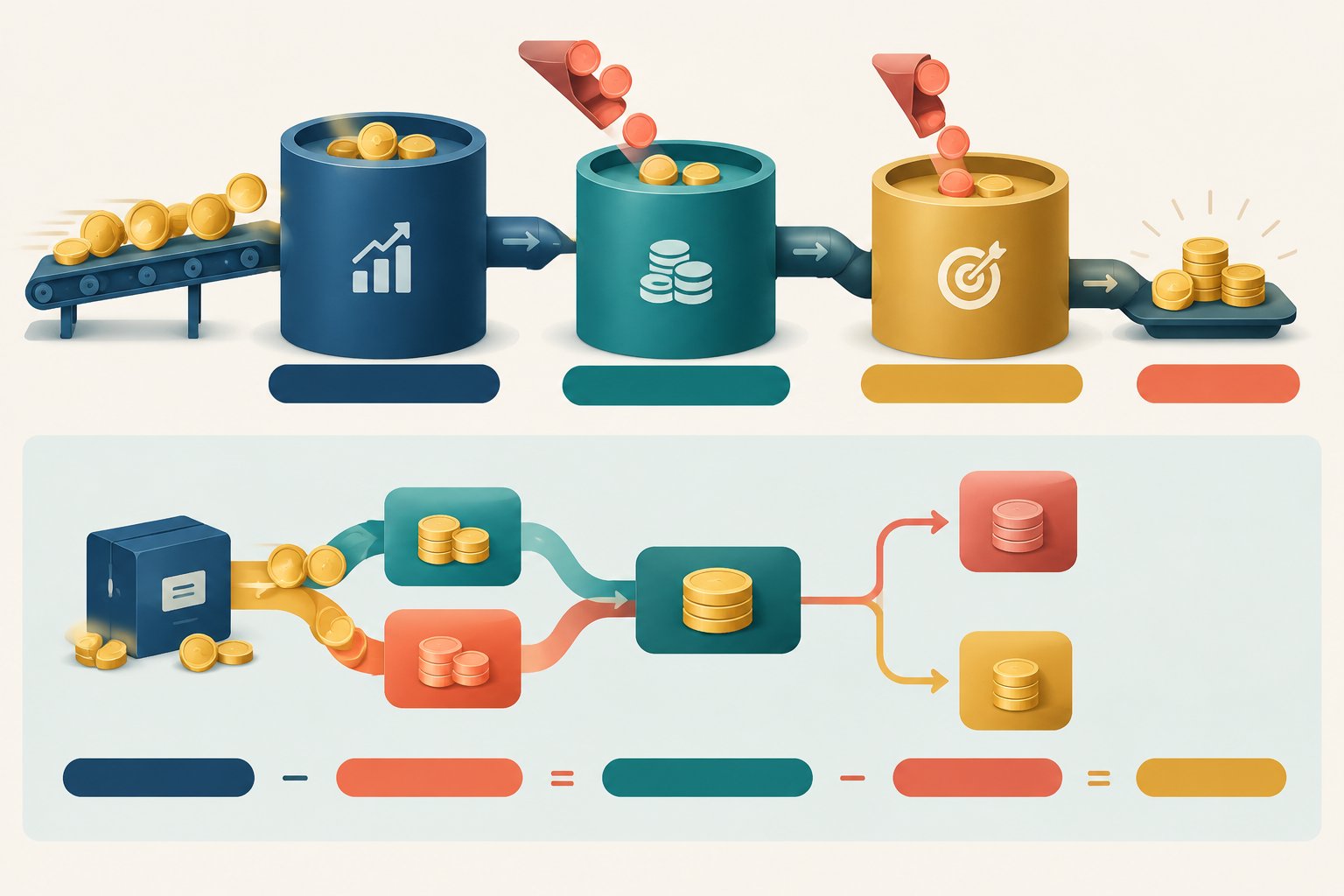
Each margin answers a different question, so you need all three. Gross margin tells you what is left after COGS. Contribution margin tells you what each sale leaves after every variable cost. Net margin tells you what the whole business kept after all costs.
Take two jobs a fit-out business completed in the same month, with labour at a loaded $73 an hour:
| Job A | Job B | |
|---|---|---|
| Revenue | $20,000 | $30,000 |
| Materials (COGS) | $7,000 | $12,000 |
| Gross margin | 65% | 60% |
| Direct labour | 80 hrs = $5,840 | 180 hrs = $13,140 |
| Subcontractor | $0 | $1,500 |
| Contribution | $7,160 | $3,360 |
| Contribution margin | 35.8% | 11.2% |
On gross margin, both jobs look fine. On contribution, Job B brought in 50% more revenue and left less than half the money behind.
Net margin sits further down. You subtract operating expenses such as rent, software and admin wages to reach EBITDA, then depreciation and amortisation to reach EBIT, then interest and tax to reach net profit. As Investopedia explains, fixed overhead is excluded from contribution margin, which makes it the better tool for judging individual products and jobs. Net margin remains the right measure for the business as a whole.
Which Jobs, Products and Customers Actually Pay Their Way?

The work that pays its way is the work whose contribution margin clears your break-even line. Anything below it is being carried by the rest of the business.
Start by tagging revenue and direct costs to each job, product line or customer in your accounting software. Then sort from worst contribution margin to best. Most owners find a small group of work is propping up the bottom line, and a few "big" customers sit near the bottom of the list.
Look for these patterns:
- Customers who ask for constant revisions, rush jobs or extra site visits
- Products with high return rates or heavy freight
- Job types where delivered margin keeps slipping below the quoted margin
- Discounted work that adds volume without adding contribution
With Job B above, the next step is diagnosis. Was it underquoted, did scope creep go unbilled, or is that client expensive to serve? Your options, in order, are to reprice, restructure the scope or step away. Capacity freed from a low-margin client can be refilled with work that clears your target.
For online retailers, the same logic applies at product level. If you sell through Shopify, our Shopify experts can help you connect sales data with product costs so you can see profit margins by SKU.
How Can You Improve Contribution Margin Without Chasing Volume?
You improve contribution margin by widening the gap between what the customer pays and what that sale costs you. Selling more of a thin-margin product only multiplies the problem.
Four levers do most of the work:
- Price with confidence. Pricing power comes from being clear about the value you deliver. Xero notes that a price rise of two to three percent can significantly improve margins if volume holds.
- Cut variable cost per sale. Renegotiate supplier rates, reduce waste and rework, and check freight and payment fees line by line.
- Shift your mix. Put sales and marketing effort behind the products and services with the highest contribution.
- Lift operational efficiency. Better quoting, templates and scheduling reduce the labour hours each job absorbs.
Discounts deserve extra care. A 20% discount on a product with a 40% contribution margin halves what that sale leaves behind, so you need twice the volume to stand still.
Improving your website's conversion rate also helps, because you pay less to acquire each sale. Our conversion rate optimisation work focuses on that cost. A business that earns more from each customer builds a competitive advantage that is hard for discount-driven rivals to match.
Why Must You Track Cash Alongside Profit?
Profit and cash measure different things, so a profitable business can still run short of money. Profit records a sale when you invoice. Cash flow records it when the customer pays.
The gap shows up in three common places:
- Slow payers: A client on net-60 terms leaves you funding wages and suppliers for two months. One example shows how net-60 payment terms create a 60-day cash deficit you pay out of pocket.
- Inventory: Stock bought upfront ties up cash until it sells.
- Growth spending: New staff, equipment or stock often come before the revenue they support.
Low-margin work and slow payment together are the worst combination. The job leaves little behind, and you wait longest to see it.
Keep enough cash reserves to cover a slow month, and review debtors weekly. Check your cash flow forecast before you accept a large job, since winning a big contract can strain the bank account for months even when the job is profitable on paper. Also set money aside for GST and tax as it comes in, so a strong quarter does not leave a painful bill.
A Practical Routine for More Profitable Growth
A simple monthly routine keeps contribution margin in view without turning you into a full-time bookkeeper.
Weekly
- Tag every direct cost and timesheet to a job or product when it is entered.
- Check cash on hand and overdue invoices.
Monthly
- Review contribution margin by job, product and customer, sorted worst to best.
- Compare quoted margin with delivered margin on completed work.
- Check net profit margin and break-even against the previous month.
Quarterly
- Review prices against current supplier and labour costs.
- Decide which customers to reprice, restructure or release.
- Set a minimum contribution margin for new quotes.
This routine also builds business value. Buyers and lenders look at the quality and consistency of your profit, and valuation multiples are applied to earnings. A business with steady contribution margins and clean records presents a stronger case than one with high sales and unclear profit.
If you want a second opinion on your numbers, our consulting work helps owners find low-margin work, review pricing and plan growth that adds profit. You can also see how this plays out for a Byron Bay beverage producer.
Grow the Work That Leaves More Behind
Sales growth is worth pursuing when each extra job, product or customer contributes enough to justify the effort. Contribution margin gives you that test in plain dollars and percentages.
Cost labour at its true rate, then compare margins across your work. Reprice or restructure what falls short, and grow what clears your target. Watch cash alongside profit so a good year on paper also shows up in your bank account.
Start this month with your five largest customers or products. Work out the contribution margin on each, and make one pricing or customer decision based on the result. If you would like help reading the numbers, contact the team.
Frequently Asked Questions
What does "revenue is vanity, profit is sanity" mean?
It means sales figures look impressive but do not pay your bills; profit does. The saying is often extended with "cash is reality" to remind you that profit only helps once the money is in the bank.
What is a good contribution margin?
A good contribution margin is one that covers your fixed costs and leaves your target profit. Benchmarks vary widely by industry, with software businesses sitting well above retail, so compare against your own break-even first.
Is contribution margin the same as gross margin?
No. Gross margin subtracts only COGS, while contribution margin subtracts every variable cost, including direct labour, commissions and fees, so it gives a clearer view of each sale.
Should I allocate overheads to each job?
For measuring job performance, no. Judge each job on contribution margin, then check at business level whether total contribution covers overheads and profit.
How often should I review contribution margin?
Review it monthly with your management reports. Check cash weekly, and revisit prices each quarter or whenever supplier and wage costs change.